

Arabic translation pending — this page is shown in English until reviewed translations ship.

Portfolio Demonstration

Before & After:
Kitchen Documentation

What actually changes when a working recipe file becomes a documented system.

The documentation is produced from real operating files — including their errors, which are shown in the sample work exactly as they were found.

Most restaurant documentation is written either by software companies as lead-generation content, or by consultants who have never run a kitchen. This practice exists because neither of those survives contact with a Friday night.

Purpose
Demonstration piece — not an operating procedure
Portfolio Sample

Every “as found” panel in this document is the author’s own working material, exactly as it was found, including the errors: the notebook page as photographed (cropped to the page, not retouched), the three recipes verbatim from a typed working recipe file. Nothing has been made worse for effect and nothing has been invented. Employer names, vendor names, and individual staff names have been removed; where a name stood in a line, the generic word stands in brackets. This document is a demonstration of method, not an operating procedure.

Source Material
Author's own 2018 working recipe file
Notebook Page
Author's own kitchen notebook, photographed
Companion Standards
Recipe & Sub-Recipe Costing Standard · Food Safety Standard · Menu Engineering & Profitability Analysis

Start Here — A Notebook Page, Photographed

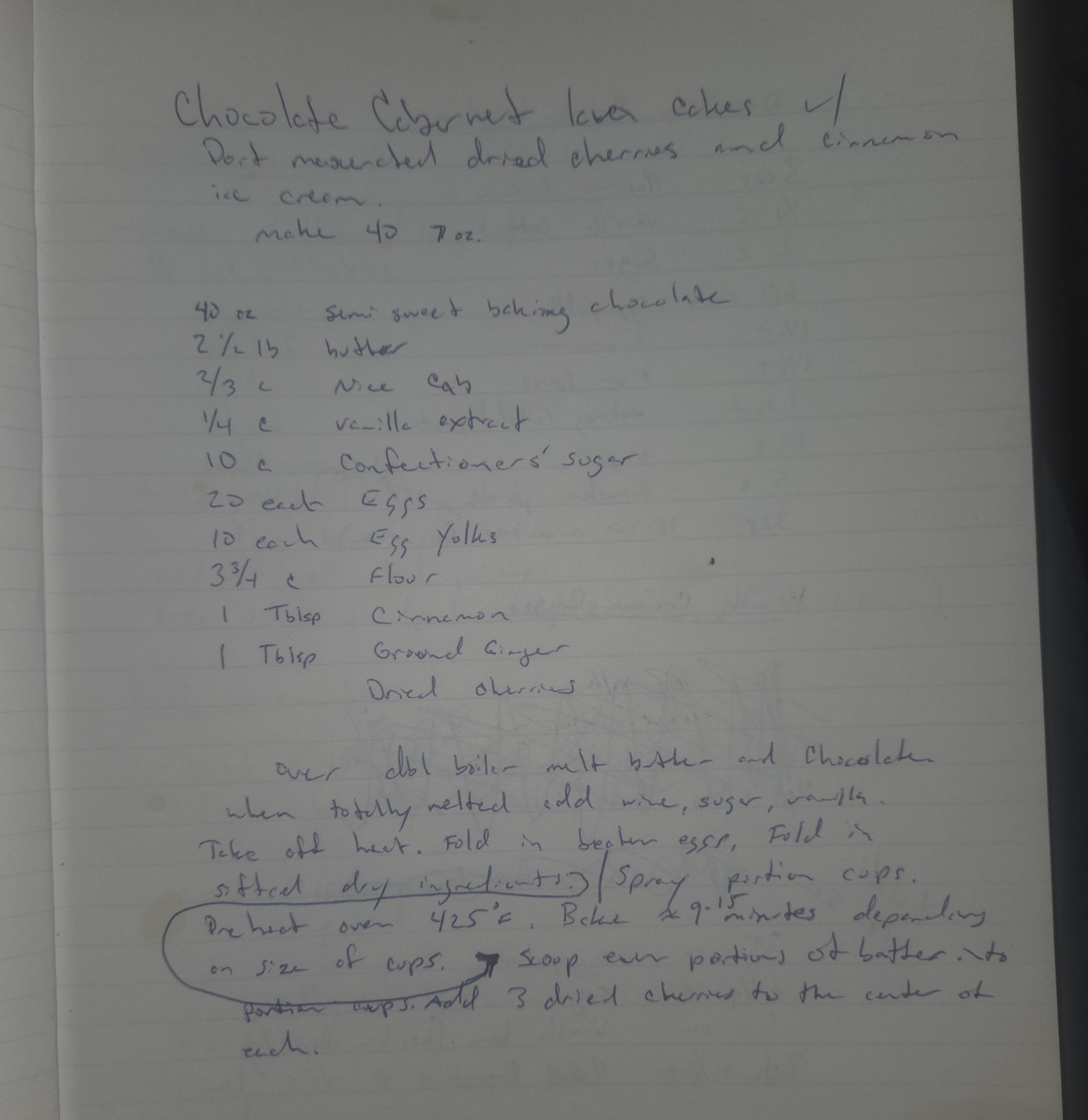
Most kitchen recipes are not in a file at all. They are in a notebook, in pen, in the shorthand of whoever wrote them. This is one page of the author’s own notebook, photographed on a phone. Capture reads it line for line, the standard rebuilds it, and everything the page does not say goes to the chef as a question.

Film · 1 min · music onlyThe notebook page in one minute: photographed, captured line for line, marked up, asked of the chef and standardized. The same photograph, reading, marks and record are set out in full below. The music is AI-generated.

Photographed

PHOTO · UNVERIFIED

A handwritten page from a kitchen notebook, in blue ink on lined paper: “Chocolate Cabernet lava cakes,” eleven ingredient lines, and a method written as one paragraph, with a loop and an arrow drawn through it.
Tap for full size

The page, as photographed

One page of a working kitchen notebook, photographed on a phone. Cropped to the page; nothing retouched, nothing made worse for effect. Switch to Captured to see what capture reads, and what an audit finds.

Captured — marked up

6 FINDINGS · 6 ABSENT · HELD

Chocolate Cabernet lava cakes w/
Port macerated dried cherries and cinnamon ice cream.
make 40 — 7 oz.

40 oz      semi sweet baking chocolate
2½ lb      butter
⅔ c        Nice Cab
¼ c        vanilla extract
10 c       confectioners' sugar
20 each    Eggs
10 each    Egg Yolks
3¾ c       flour
1 Tblsp    Cinnamon
1 Tblsp    Ground Ginger
           Dried cherries

Over dbl boiler melt butter and chocolate.
When totally melted add wine, sugar, vanilla. Take off heat.
Fold in beaten eggs. Fold in sifted dry ingredients.
Spray portion cups.
Preheat oven 425°F. Bake ≈ 9-15 minutes depending on size of cups.
Scoop even portions of batter into portion cups. Add 3 dried cherries to the center of each.

Read by capture

The capture step's reading of the photo, line for line. Shorthand is kept, gaps stay gaps, and allergens are never read at capture. This reading was read in full by the chef who wrote it on 2 Aug 2026; a second, magnified read on 29 Sept caught three small marks the first read missed (w/, °F, ≈), and the chef corrected them.

Present but wrong

  • A yield that reads two ways “make 40 — 7 oz.” Forty cakes, but is 7 oz the cup or the cake? The two readings cost differently.
  • An ingredient named by opinion “Nice Cab” — nobody can order that from a supplier.
  • Weight and volume in one list Ounces, pounds, cups and tablespoons. Cups of flour and powdered sugar weigh differently sifted and scooped.
  • An ingredient with no quantity The list gives none. The method does.
  • Bake, written before the batter is in the cups On the page the bake line comes before the scoop line. The writer’s own loop and arrow run past it.
  • Yolks listed, never used Ten yolks in the list; the method never says where they go.

Not present at all

Standardized

STANDARDIZED

CHOCOLATE CABERNET LAVA CAKES

Added: Allergens — Wheat, Milk, Eggs Flour (wheat); butter (milk); whole eggs and yolks (eggs). The semi-sweet chocolate may declare more; check its label. Signed by the chef, 29 Sept 2026.

Yield
40 CAKES · one per 7 OZ portion cup
Measures
Volume lines: weigh at the next production
Added: Serve With
Port-macerated dried cherries (garnish) · cinnamon ice cream — recipes still to be written
Added: Station · Shelf Life
Station: confirm · shelf life: confirm

Ingredients

  • Semi-sweet baking chocolate 40 OZ
  • Butter 2½ LB
  • Cabernet Sauvignon (the page: “Nice Cab”) ⅔ C
  • Vanilla extract ¼ C
  • Confectioners’ sugar 10 C
  • Eggs, whole 20 EA
  • Egg yolks 10 EA
  • Flour 3¾ C
  • Cinnamon 1 TBSP
  • Ground ginger 1 TBSP
  • Dried cherries, plain (3 per cake) 120 EA

Method

  1. Preheat the oven to 425°F. Spray 40 portion cups (7 OZ).
  2. Over a double boiler, melt the butter and chocolate.
  3. When fully melted, add the wine, confectioners’ sugar and vanilla. Take off the heat.
  4. Beat the whole eggs and yolks together; fold in.
  5. Sift the flour, cinnamon and ginger together; fold in.
  6. Scoop even portions of batter into the cups. Add 3 dried cherries to the center of each.
  7. Bake about 9–15 minutes, depending on the size of the cups.
  8. Added: Pull when slightly soufflé’d but still runny in the middle.
What Was Corrected, and What Was Not
  1. Yield restated as 40 cakes, one per 7 oz portion cup. The page says “make 40 — 7 oz.” By standard cup weights the batch comes to roughly 185 oz, under 5 oz of batter a cake, which reads like a 7 oz cup rather than a 7 oz cake. That was a reading, not a fact, so the record asked instead of choosing; the chef confirmed the cup.

  2. “Nice Cab” named as Cabernet Sauvignon, with the writer’s own words kept beside it. Whoever orders the wine next may not be the person who wrote the page.

  3. Quantities kept as written, in one notation, and every volume line marked to be weighed at the next production. Converting cups of flour and powdered sugar from a table would put a guess into a standard; weighing the batch once closes it.

  4. The dried cherries take their quantity from the page’s own method: three in each of forty cakes is 120. The chef confirmed they are plain dried cherries; the port-macerated ones are the garnish.

  5. The method is rebuilt as numbered steps in production order: oven and cups first, bake last, because the batter has to be in the cups before they go in. On the page the bake line sits before the scoop line, and the writer’s own loop and arrow run past it.

  6. Ten yolks are listed and the method never uses them. The record asked; the chef confirmed they are beaten in with the whole eggs, and step 4 now says so.

  7. “9-15 minutes depending on size of cups” is a window, not a test. The record asked rather than borrowing a cue from someone else’s recipe, and the last step now carries the chef’s own words.

  8. The page names two accompaniments, the port-macerated dried cherries (the garnish) and cinnamon ice cream, with no recipe for either. They are listed as components still to be written; the plate cannot be costed until they are.

  9. No allergen declaration. Capture never reads allergens off a photo: a misread word there is the one mistake a kitchen cannot absorb. The row was drawn from the ingredient list and signed by the chef, and the chocolate is sent to its own label for anything more.

  10. Station and shelf life added as fields, both marked to confirm rather than guessed.

Capture never guesses. A word it cannot read is marked unreadable, with the crop of the photo kept as evidence. Shorthand stays shorthand until the chef says what it means. Allergens are never read off a photo at all. The chef reads the capture before anything is standardized.

Why This Document Exists

Every other sample in this portfolio shows a finished document. None of them show the thing an operator actually recognizes: the messy file the finished document came from.

This piece closes that gap. Each of the three transformations below is a real recipe from a real working kitchen file, shown exactly as it was found, next to the version a documented kitchen would run on. The intent is not to demonstrate that clean documents look nicer than messy ones — that is obvious and not worth a page. It is to show precisely which failures get found, how each one is corrected, and what the correction is worth.

The source file used here is the author’s own. Using someone else’s mess to sell documentation services would be both distasteful and unconvincing — a chef can tell a manufactured example from a real one immediately. Every problem shown below is a problem the author left in his own working file, found by auditing it years later against the standards in this portfolio.

How to Read This Document

  • As found The source material, verbatim. Line breaks, unit inconsistencies, and run-together text are reproduced as found.
  • Marked up Each defect the correction notes address is flagged in place and keyed to its note, with a separate ledger for what is not there at all.
  • Standardized The same recipe rebuilt to the standardized format.
  • Correction notes Each specific correction made, and why it matters operationally rather than cosmetically.

The Same Recipe, Filed Twice, Under Two Names

Two entries sit in the same recipe file under different names. Compared line by line, they are byte-for-byte identical — same ingredients, same quantities, same method, same yield. Neither entry references the other.

As found

UNVERIFIED

Warm shallot vin

Yield 1 qt
Shaved shallot 1 pt
Brown sugar ¼ C.
Dijon mustard 1 T.
Sherry vinegar 1 ½ C.
Mushroom conserva oil 2 ¾ C.
S&P to taste
Minced shallot ½ C.

Sweat shallots in sauce pot
Add sugar, vinegar and mustard.
Reduce by ¼ the volume (3/4 yield).
Blend until smooth, on high, in [a high-speed blender].
Stream in conserva oil to emulsify.
Strain through chinoise
Season with S&P and minced shallots.
Cool in ice bath.

- - - - - - - - - - - - - - - - - -

Conserva Vinaigrette

Yield 1 qt
Shaved shallot 1 pt
Brown sugar ¼ C.
Dijon mustard 1 T.
Sherry vinegar 1 ½ C.
Mushroom conserva oil 2 ¾ C.
S&P to taste
Minced shallot ½ C.

[method identical to above]

The file, as received

Verbatim from a working recipe file. Nothing has been made worse for effect, and nothing has been invented. Switch to Marked up to see what an audit finds.

Marked up

5 FINDINGS · 5 ABSENT · HELD

Warm shallot vin

Yield 1 qt
Shaved shallot 1 pt
Brown sugar ¼ C.
Dijon mustard 1 T.
Sherry vinegar 1 ½ C.
Mushroom conserva oil 2 ¾ C.
S&P to taste
Minced shallot ½ C.

Sweat shallots in sauce pot
Add sugar, vinegar and mustard.
Reduce by ¼ the volume (3/4 yield).
Blend until smooth, on high, in [a high-speed blender].
Stream in conserva oil to emulsify.
Strain through chinoise
Season with S&P and minced shallots.
Cool in ice bath.

- - - - - - - - - - - - - - - - - -

Conserva Vinaigrette

Yield 1 qt
Shaved shallot 1 pt
Brown sugar ¼ C.
Dijon mustard 1 T.
Sherry vinegar 1 ½ C.
Mushroom conserva oil 2 ¾ C.
S&P to taste
Minced shallot ½ C.

[method identical to above]

Present but wrong

  • Filed twice, under two names Two entries, identical line for line. Neither references the other.
  • A yield with no portion count “1 qt” gives a volume. It cannot give a cost per portion.
  • Mixed units, no ordering Pints, cups, and tablespoons in one list — slow to cost, error-prone to scale.
  • A reduction that reads two ways Remove a quarter, or reduce to a quarter? One reading ruins the batch.
  • Cooling with no target No temperature, and no link to the food safety standard.

Not present at all

Standardized

STANDARDIZED

CONSERVA VINAIGRETTE

Also Known As
Warm Shallot Vinaigrette
Yield
1 QT (32 FL OZ) · 32 × 1 FL OZ
Added: Allergens
Mustard (Dijon). Contains no major U.S. allergens.
Added: Station · Shelf Life
Garde manger · shelf life: confirm

Ingredients

  • Shallot, shaved 16 OZ (1 PT)
  • Sherry vinegar 12 FL OZ (1½ C)
  • Mushroom conserva oil 22 FL OZ (2¾ C)
  • Brown sugar 1.75 OZ (¼ C)
  • Dijon mustard 0.5 OZ (1 TBSP)
  • Shallot, minced 4 OZ (½ C)
  • Salt and pepper TO TASTE

Method

  1. Sweat shaved shallots in a sauce pot until translucent.
  2. Add brown sugar, sherry vinegar, and Dijon. Reduce by ¼ volume (to 75% of starting volume).
  3. Blend on high in a high-speed blender until smooth.
  4. Stream in conserva oil to emulsify.
  5. Strain through chinois.
  6. Season with salt, pepper, and minced shallot.
  7. Cool in an ice bath to 41°F or below per the Food Safety Standard.

Added: Cost

BATCH: _____ · PER PORTION: _____

Cost it with your prices

Type the prices from your own invoices and the cost per portion resolves as you go. Nothing is sent or stored.

  • Shallot, shaved 16 OZ (1 PT)

    Line cost —
  • Sherry vinegar 12 FL OZ (1½ C)

    Line cost —
  • Mushroom conserva oil 22 FL OZ (2¾ C)

    Made in house — its cost comes from its own record, not an invoice.

    Line cost —
  • Brown sugar 1.75 OZ (¼ C)

    Line cost —
  • Dijon mustard 0.5 OZ (1 TBSP)

    Line cost —
  • Shallot, minced 4 OZ (½ C)

    Line cost —
  • Salt and pepper TO TASTE

    Not costed — no quantity

Weight lines price by weight and volume lines by volume — converting between them needs a density the record doesn’t state, so the sheet doesn’t guess.

Priced
0 of 6 lines
Batch cost
—
Per 1 FL OZ portion
—
  • Type a price on any line to begin.
  • Salt and pepper not costed (to taste).
  • Per-portion cost is the batch cost divided by 32 portions.

What Was Corrected
  1. One canonical name, with the alias recorded. Two names for one product is not a filing annoyance — it is how a kitchen ends up with two prep containers, two line entries, and two cooks each believing theirs is the real one. It also breaks costing and menu engineering, because sales and usage split across two records that never get added together.

  2. Yield restated with portion count. "1 qt" tells you volume; "32 portions at 1 fl oz" tells you cost per portion, which is the number the costing standard actually needs.

  3. Allergens declared explicitly, including the negative finding. Recording that a recipe contains no major allergens is as operationally useful as recording that it does — it lets a manager answer a guest without reverse-engineering the ingredient list mid-service.

  4. Station assignment and shelf life added. Shelf life is marked for confirmation rather than guessed — see The Recipe With No Method on how unknowns are handled.

  5. Ingredients converted to weight where practical and reordered by quantity. The original mixed volume and weight units with no ordering logic, which makes scaling error-prone and costing slow.

  6. "Reduce by ¼ the volume (3/4 yield)" clarified. The original phrasing is genuinely ambiguous about whether you are removing a quarter or reducing to a quarter — a cook reading it fast in a hot kitchen can go either way, and one of those two readings ruins the batch.

  7. Cooling step tied to the food safety standard by section reference, so the recipe and the safety procedure cannot drift apart.

  8. Cost fields added so the recipe feeds directly into the Recipe & Sub-Recipe Costing Standard rather than requiring a separate transcription step.

The Recipe That Cannot Be Read

This entry was originally laid out in two columns. At some point the file was converted or copied, the columns collapsed into each other, and nobody caught it. It has been sitting in the working file in this condition ever since — and it also carries an unflagged allergen problem. It is shown here in two panels, because the correction itself is a split: the original ran a sauce recipe and a plating procedure together as one undifferentiated entry, and the first job is to separate them.

As found

UNVERIFIED

Cauliflower Romesco

2 tbl green peas
1tbl pine nuts 3 red peppers roasted
and skinned
1tbl soybeans ¼ cup marcona almonds
1tbl softened golden raisins ¼ cup
sherry vinegar
6oz tri-colored cauliflower ¼" pieces
1 roma tomato concasse
1 oz. fresh lemon juice ¼ cup roasted
garlic and garlic oil
Salt and pepper to taste 1 tsp Basque
pepper or espelette

Sauce ingredients and plate components are interleaved in the same block, with no indication which belongs to which.

[continued — same entry]

Now that the Romesco sauce is created
you can sauté the cauliflower in a
tablespoon of canola oil until it is
slightly soft in texture and
caramelized. Once the cauliflower has
reached desired doneness add the
soybeans, golden raisins, and pine nuts.
Sauté for at least 45 seconds or just
until the soybeans are warm and then add
salt/pepper to taste and finish with a
fresh squeeze of lemon juice. Serve all
of the vegetables over the romesco sauce
and garnish with pea tendrils and enjoy.

No portion size. No allergen note. No separation between sauce production and plate pickup. Quantities for the plate components are back in the block above.

The file, as received

Verbatim from a working recipe file. Nothing has been made worse for effect, and nothing has been invented. Switch to Marked up to see what an audit finds.

Marked up

3 FINDINGS · 2 ABSENT · HELD

Cauliflower Romesco

2 tbl green peas
1tbl pine nuts 3 red peppers roasted
and skinned
1tbl soybeans ¼ cup marcona almonds
1tbl softened golden raisins ¼ cup
sherry vinegar
6oz tri-colored cauliflower ¼" pieces
1 roma tomato concasse
1 oz. fresh lemon juice ¼ cup roasted
garlic and garlic oil
Salt and pepper to taste 1 tsp Basque
pepper or espelette

Sauce ingredients and plate components are interleaved in the same block, with no indication which belongs to which.

[continued — same entry]

Now that the Romesco sauce is created
you can sauté the cauliflower in a
tablespoon of canola oil until it is
slightly soft in texture and
caramelized. Once the cauliflower has
reached desired doneness add the
soybeans, golden raisins, and pine nuts.
Sauté for at least 45 seconds or just
until the soybeans are warm and then add
salt/pepper to taste and finish with a
fresh squeeze of lemon juice. Serve all
of the vegetables over the romesco sauce
and garnish with pea tendrils and enjoy.

No portion size. No allergen note. No separation between sauce production and plate pickup. Quantities for the plate components are back in the block above.

Present but wrong

  • Tree nuts and soy, declared nowhere Marcona almonds and pine nuts (tree nuts), soybeans (soy) — two of the nine major U.S. allergens, with no warning anywhere. The sauce now declares the almonds; the plate declares the pine nuts and soy.
  • Allergens missing where the plate is built The plating step adds soybeans and pine nuts. Nothing on the dish says so.
  • Sauce and plate fused into one entry A sauce recipe and a plating procedure run together as one undifferentiated block.

Not present at all

  • Yield ABSENT
  • Portion size ABSENT see the note under the file

Kept as written

  • Basque pepper or espelette A genuine either/or in the original. Kept explicit, not silently resolved.

Standardized

STANDARDIZED

Extracting the Sub-Recipe

ROMESCO SAUCE (SUB-RECIPE)

Allergens — Tree Nuts Contains marcona almonds. Prepared on shared equipment. See the Food Safety Standard.

Added: Yield
Confirm at next production

Ingredients

  • Red pepper, roasted, skinned 3 EA
  • Roma tomato, concasse 1 EA
  • Marcona almonds ¼ CUP
  • Roasted garlic + garlic oil ¼ CUP
  • Sherry vinegar ¼ CUP
  • Basque pepper (or espelette) 1 TSP
  • Salt and pepper TO TASTE

Method

  1. Blend roasted pepper and tomato on low to a chunky consistency.
  2. Add roasted garlic and almonds; blend to a near-smooth purée.
  3. Emulsify in garlic oil, sherry vinegar, and Basque pepper to a smooth finish.
  4. Season with salt and pepper.

Rebuilding the Plated Dish

CAULIFLOWER ROMESCO (PLATED)

Allergens — Tree Nuts, Soy Almonds and pine nuts (tree nut); soybeans (soy).

Portion
6 OZ cauliflower per plate

Components

  • Romesco sauce (SUB-RECIPE) 2 OZ
  • Cauliflower, tri-color, ¼" dice 6 OZ
  • Green peas 2 TBSP
  • Soybeans 1 TBSP
  • Golden raisins, softened 1 TBSP
  • Pine nuts 1 TBSP
  • Lemon juice, fresh 1 OZ
  • Pea tendrils GARNISH

Pickup

  1. Sauté cauliflower in canola oil until lightly softened and caramelized.
  2. Add soybeans, raisins, and pine nuts; sauté 45 sec until warmed through.
  3. Season; finish with lemon juice.
  4. Spoon romesco to base of plate, mound vegetables over, garnish with tendrils.

What was corrected — and what was not

  1. Tree nuts and soy, declared nowhere
  2. Added: Yield
  3. Basque pepper or espelette (kept as written)
  4. Allergens missing where the plate is built
  5. Sauce and plate fused into one entry

Shaded: fields the file lacked entirely — see “Not present at all”.

What Was Corrected
  1. Allergen declaration added to the sub-recipe. This is the most consequential fix in the entire document. The original entry contains marcona almonds and pine nuts — tree nuts — and soybeans, which is soy. Both are among the nine major allergens recognized under U.S. federal labeling law, and neither appears anywhere in the original as a warning. A server fielding an allergy question would have had to read a collapsed, half-legible ingredient list mid-service to find them.

  2. Yield marked for confirmation. The original states no yield at all, which means this recipe cannot be costed, cannot be portioned consistently, and is invisible to menu engineering analysis under the Menu Engineering & Profitability Analysis.

  3. "Basque pepper or espelette" retained as written, with the substitution kept explicit rather than silently resolved. Where a genuine either/or exists in the original, flattening it to one option quietly changes the dish.

  4. Allergens repeated on the plated dish, not just the sub-recipe. Allergen information has to appear wherever a cook or server will actually look — inheriting it silently from a component recipe is how it gets missed.

  5. Sub-recipe separated from plated dish and cross-referenced by number. The original ran a sauce recipe and a plating procedure together in one undifferentiated block. Separating them means the sauce is costed once and referenced everywhere it appears, per the Recipe & Sub-Recipe Costing Standard.

A note on the allergen finding: this is not a hypothetical illustration constructed for a sales document. It is a genuine, unflagged tree nut and soy exposure that sat in a working kitchen file. It was found by running the file against the standardized format — which is precisely what a documentation audit is for. Most kitchens have at least one of these. Very few know which one.

The Recipe With No Method

This entry has a complete ingredient list, a heading that reads “Instructions:”, and then nothing. The method was never written. It is worth showing because of how the correction is handled — this is where a documentation process either earns trust or quietly destroys it.

As found

UNVERIFIED

Thai Green Curry Paste

Cilantro 45g Shallot 90g Lemongrass 15g
Jalapeno 12g garlic cloves 12 ginger 27g
Lime juice 42g coconut milk 270g fish
sauce 36g shrimp paste 21g white pepper
3g cumin 3g coriander 3g brown sugar 15g

Instructions:


[nothing follows — the next line in the
file is the start of a different recipe]

The file, as received

Verbatim from a working recipe file. Nothing has been made worse for effect, and nothing has been invented. Switch to Marked up to see what an audit finds.

Marked up

3 FINDINGS · 1 ABSENT · HELD

Thai Green Curry Paste

Cilantro 45g Shallot 90g Lemongrass 15g
Jalapeno 12g garlic cloves 12 ginger 27g
Lime juice 42g coconut milk 270g fish
sauce 36g shrimp paste 21g white pepper
3g cumin 3g coriander 3g brown sugar 15g

Instructions:


[nothing follows — the next line in the
file is the start of a different recipe]

Present but wrong

  • Fish and shellfish, unflagged Fish sauce and shrimp paste — two more of the nine major U.S. allergens, declared nowhere.
  • A bare number in a list of grams “garlic cloves 12” — twelve cloves, or twelve grams? The two readings differ roughly fourfold.
  • A method heading with nothing under it “Instructions:” — and then the next recipe in the file.

Not present at all

Standardized — not cleared

INCOMPLETE · NOT CLEARED FOR PRODUCTION

THAI GREEN CURRY PASTE

Added: Status — Method Not Documented This recipe is not cleared for production until the method is confirmed by the originating chef.

Allergens — Fish, Crustacean Shellfish Fish sauce (fish); shrimp paste (crustacean shellfish).

Yield
Confirm at next production

Ingredients

  • Coconut milk 270 G
  • Shallot 90 G
  • Cilantro 45 G
  • Lime juice 42 G
  • Fish sauce 36 G
  • Ginger 27 G
  • Shrimp paste 21 G
  • Brown sugar 15 G
  • Lemongrass 15 G
  • Jalapeño 12 G
  • Garlic cloves 12 EA
  • White pepper 3 G
  • Cumin 3 G
  • Coriander 3 G

Method

TO BE CONFIRMED. Not written from assumption.

Open Questions for the Chef

  • Are the dry spices toasted before grinding?
  • Is this blended raw, or cooked out?
  • Is coconut milk blended in, or added after the paste is made?

What was corrected — and what was not

  1. Added: Version and production status
  2. Fish and shellfish, unflagged
  3. A bare number in a list of grams
  4. A method heading with nothing under it (left blank on purpose)

Shaded: fields the file lacked entirely — see “Not present at all”.

What Was Corrected, and What Deliberately Was Not
  1. The recipe is explicitly marked not cleared for production. It stays in the system, visible, with its gap labeled — rather than being quietly dropped or quietly completed.

  2. Allergens declared from the ingredient list, which can be done with certainty even though the method cannot. Fish sauce and shrimp paste put fish and crustacean shellfish in this recipe — two more of the nine major allergens, unflagged in the original.

  3. "garlic cloves 12" disambiguated to 12 each rather than 12 grams. In a list where every other line is a gram weight, a bare number is a genuine ambiguity, and the two readings differ by roughly a factor of four.

  4. The method was left blank on purpose. A plausible green curry method could be written in thirty seconds — and it would be a guess wearing the authority of a standardized document, which is considerably more dangerous than an obvious blank. The open questions are listed instead, so a five-minute conversation with the chef closes the gap properly.

This is the difference between documentation and transcription. Anyone can retype a recipe into a nicer template. The value is in knowing which gaps must be escalated rather than filled — and in producing a document whose blanks are honest, so that everything that is filled in can be trusted.

The Failure Modes, Named

These are the specific problems found in a single working recipe file. Each is common enough that most operators will recognize several immediately.

Failure ModeWhat It Looks LikeWhat It Actually Costs
Duplicate under a different nameOne recipe filed twice with two titles; neither references the otherSplit inventory and sales records; two cooks working from two "official" versions
Missing yieldNo stated batch size or portion countThe item cannot be costed, cannot be portioned consistently, and is invisible to menu analysis
Undeclared allergenTree nuts, soy, fish, or shellfish present in the ingredients but flagged nowhereDirect guest safety and liability exposure
Collapsed formattingTwo-column layouts run together into unreadable linesMisreads on the line; slow onboarding; quantities transposed between ingredients
Empty or missing methodAn "Instructions:" heading with nothing under itThe dish exists only in one person’s head and leaves when they do
Sub-recipe fused to plated dishSauce production and plate assembly written as one blockThe component gets re-costed every time it appears, or not costed at all
Inconsistent units and scalesGrams, ounces, cups, and "1 T." in one list; Celsius and Fahrenheit in one fileScaling errors; slow costing; conversion mistakes under pressure
No version control"v1" and "v2" both present with no indication which is currentCooks pick whichever they find first
Unresolved author’s notesQuestion marks and placeholders left in the textThe uncertainty is silently inherited by whoever cooks it next
Non-recipe content filed as recipeEquipment manual text pasted into the recipe fileSearching gets slower; the file stops being trusted as a reference

The Standardized Format

Every recipe in a documented kitchen carries the same fields, in the same order, so that a cook, a manager, and a costing spreadsheet can each find what they need in the same place every time.

  • Canonical name + recipe number One name per product; the number is what other documents reference
  • Version + revision status Makes the current version unambiguous and lets incomplete recipes stay visible without being trusted
  • Aliases Captures what the dish has been called historically so old names still find it
  • Yield and portion count The input costing and menu engineering both depend on
  • Allergen declaration Stated affirmatively, including when none are present
  • Station assignment Tells you whose prep list this belongs on
  • Shelf life Drives labeling and rotation
  • Ingredients, ordered by quantity Scannable, scalable, and fast to cost
  • Numbered method Executable under pressure by someone who has not made it before
  • Cross-references to standards Keeps the recipe and the food safety procedure from drifting apart
  • Cost fields Feeds the Recipe & Sub-Recipe Costing Standard without a separate transcription step

What Disorganization Actually Costs

The case for documentation is usually made in vague terms — consistency, professionalism, peace of mind. Those are real but unquantifiable, and an owner has heard them before. The concrete version is narrower and harder to argue with:

  1. A recipe with no stated yield cannot be costed. An item that cannot be costed cannot be priced against a target food cost, and is excluded from menu engineering analysis entirely — which means the one process that tells you whether a dish earns its place on the menu simply cannot see it.

  2. A recipe filed twice under two names splits its own sales and usage history across two records. Neither record is accurate, and the item’s true performance is invisible until someone notices the duplication.

  3. An undeclared allergen is a liability exposure that persists until someone finds it. In the file examined here, four of the nine major U.S. allergens appeared in recipes that flagged none of them.

  4. A dish with no written method exists only in the head of whoever last made it. Its shelf life as an asset is exactly that person’s tenure.

  5. Every hour a senior cook spends explaining an unreadable recipe to a new hire is an hour of skilled labor paid twice — once to the person asking and once to the person answering.

None of the above requires a study or an industry statistic to establish. Each one follows directly from the documents themselves, which is why they are worth stating plainly rather than dressing up with borrowed percentages.

What a Documentation Engagement Covers

  1. Audit

    Existing recipes, prep lists, and manuals are inventoried and run against the standardized format. Duplicates, missing yields, undeclared allergens, and incomplete methods are listed with severity.

  2. Triage

    Findings are ranked. Allergen gaps and food safety issues are corrected first; formatting and consistency follow.

  3. Rebuild

    Recipes are rewritten to the standardized format. Gaps that require the chef’s knowledge are flagged as open questions rather than filled by assumption.

  4. Confirmation

    Open questions are resolved with the chef in a single consolidated pass rather than piecemeal.

  5. Integration

    Finished recipes feed the costing standard, and from there into menu engineering analysis.

  6. Handover

    The operation receives the completed documents plus the standard itself, so new recipes can be added in the same format without further engagement.

Documentation Self-Audit

Ten questions. Any “no” is a gap worth closing; three or more suggests the documentation is not currently able to support consistent costing or allergen response.

  1. Does every recipe state a yield and a portion count? YES / NO
  2. Does every recipe carry an explicit allergen declaration, including when none are present? YES / NO
  3. Is there exactly one canonical name per product, with old names recorded as aliases? YES / NO
  4. Can you tell, for any recipe, which version is current and approved? YES / NO
  5. Are sub-recipes costed once and referenced by number, rather than re-costed in each dish? YES / NO
  6. Could a competent cook who has never made a dish execute it from the written recipe alone? YES / NO
  7. Are units consistent enough that a recipe can be scaled without conversion errors? YES / NO
  8. Is every recipe costed against invoices from the current quarter? YES / NO
  9. Do your recipes reference your food safety procedures, so the two cannot drift apart? YES / NO
  10. If the chef left tomorrow, would the menu survive intact in writing? YES / NO

The last question is the one that matters most, and it is the one most operators have never actually tested.

What This Practice Produces

Not advice. Documents — specific, finished artifacts that a kitchen uses on the floor.

  • Kitchen Opening & Training Program

    A new hire becomes competent on a documented schedule instead of by shadowing whoever is on shift.

  • Recipe & Sub-Recipe Costing Standard

    Every recipe becomes costable, which makes pricing defensible.

  • Food Safety Standard

    Time, temperature, allergen, and hygiene procedures consolidated into one reference, organized by workflow.

  • Reduced Oxygen Packaging Standard

    Sous vide and vacuum-packing operations documented against their regulatory requirements.

  • Fermentation & Curing Standard

    Vegetable ferments through charcuterie, organized by risk tier.

  • Menu Engineering & Profitability Analysis

    Identifies which items earn, which underearn, and what to do about each.

  • Recipe Library, Volume 1: Savory Foundations — The SOP Edition

    Standardized, allergen-declared, costable components, ready to use. 121 recipes.

How an Engagement Works — In Writing

  1. You complete the sixteen-question audit. It scores itself as you answer and names your gaps on the spot.

  2. You send the results in one click. Email, not a call.

  3. You receive a written diagnosis: which gaps are liability, which are cost, and which matter most.

  4. Engagements begin with a $99 Documentation Review of your actual materials — a written findings report, ranked by severity.

  5. The findings justify whatever comes next — or they don't. The review stands on its own either way.

The written-only model is a deliberate constraint, not a limitation. Everything arrives in a form you can check, forward, and keep — and nothing requires you to take another meeting.

The Problem, Stated Plainly

  1. A recipe with no stated yield cannot be costed. An item that cannot be costed cannot be priced against a target — and is invisible to any analysis of whether it earns its place on the menu.

  2. A dish with no written method exists only in the head of whoever last made it. Its shelf life as a business asset is exactly that person's tenure.

  3. An undeclared allergen is a liability exposure that persists silently until someone finds it — or until a guest does.

  4. Every hour a senior cook spends explaining an unreadable recipe to a new hire is skilled labor paid twice.

None of these requires an industry statistic to establish. Each follows directly from the state of the documents themselves — which is why this site demonstrates rather than pitches.


This document is a portfolio demonstration piece. The as-found panels are verbatim source material from the author’s own working files, reproduced with their original errors intact. Engagements begin with the audit described in What a Documentation Engagement Covers.

contact@thekitchenfieldbook.com